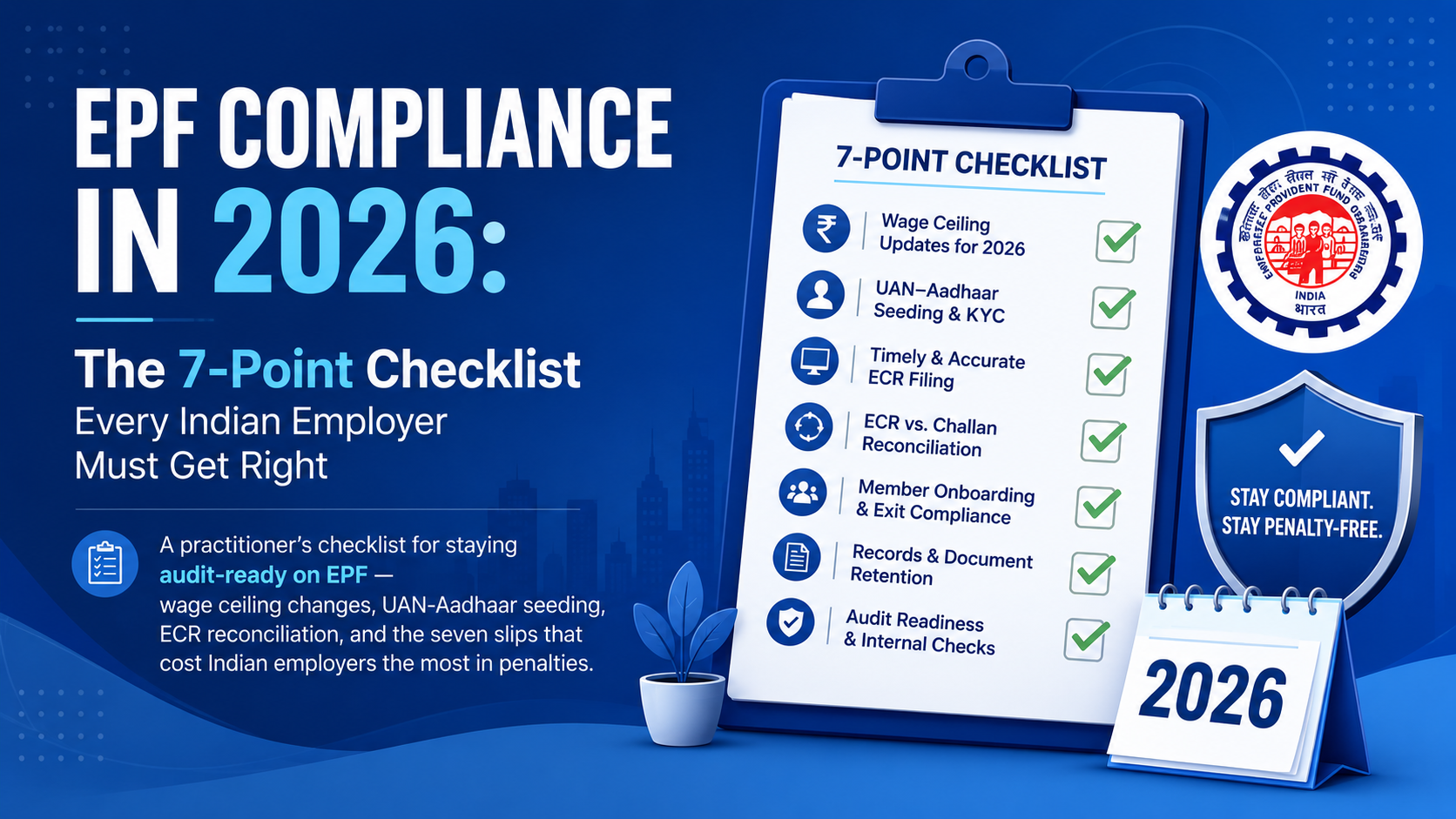
EPF Compliance in 2026: The 7-Point Checklist Every Indian Employer Must Get Right
A practitioner's checklist for staying audit-ready on EPF — wage ceiling changes, UAN-Aadhaar seeding, ECR reconciliation, and the seven slips that cost Indian employers the most in penalties.
Quick read: 8 minutes · For HR heads, payroll managers, founders and finance teams running EPF compliance for 20+ employees.
Every quarter, the same quiet question lands on a CFO's desk: "are we missing anything on PF?"
In 25+ years of running EPFO compliance for businesses across Karnataka and pan-India, we've watched the same seven slips repeat. They're rarely about intent — they're about a deadline drifting on a spreadsheet, or a regulation update that didn't make it into the payroll software.
Here is the checklist we run for every new client in their first 30 days. Use it as a self-audit before the next ECR cycle.

1. UAN-Aadhaar seeding for every active employee
Without an Aadhaar-seeded, KYC-verified UAN, the EPFO portal will silently reject the credit. The employee sees their PF deducted from their salary but no entry in their passbook — and you only discover it during their exit or a grievance.
Action this week:
- Pull the EPFO Member portal "KYC pending" list
- Cross-check against your active payroll roster
- For every mismatch, raise an e-Sewa Aadhaar seeding request
💡 From the desk: We've onboarded clients where 30–40% of UANs were unseeded. The fix is mechanical but takes 2–3 working days per 100 employees.
2. Wage ceiling recalibration (the ₹15,000 → ₹21,000 conversation)
If the wage ceiling change has been notified for your sector, your salary structures need re-doing — not just the EPF column. It cascades to:
- ESI eligibility cut-off
- Gratuity calculation base
- LWF contribution slabs
- Bonus eligibility under the Payment of Bonus Act
Don't just bump the EPF contribution and move on. Run the full re-structure with a compliance partner.
3. Monthly ECR — the 15th is non-negotiable
| What's due | By when | Penalty if missed |
|---|---|---|
| Contribution deposit (employer + employee share) | 15th of the following month | ₹5/day per day of delay |
| ECR upload | 15th of the following month | 12% interest p.a. on dues |
| Damages under Section 14B | After 30 days | 5–25% of the dues |
Real example: A 200-employee client we audited had drifted 4 days on three consecutive months. The compounding interest + damages over two quarters: ₹3.8 lakh.

4. Reconciliation between payroll and the EPFO portal
Your payroll software shows ₹X deducted. The EPFO portal shows ₹Y credited. In 60% of audits we run, X ≠ Y.
Causes we see most often:
- Mid-month joiners not added to the ECR
- Resigned employees still in the ECR
- Wage component mis-mapping (LTA, food allowance wrongly added to PF wages)
- Arrears from salary revisions not reflected in PF wages
The fix: a monthly two-way reconciliation. Payroll → ECR → EPFO portal passbook. Three checkpoints, signed off by two people. We call it the four-eye review.
5. Exit settlements within 30 days
When an employee resigns:
- Within 2 days: mark date of exit on the EPFO portal
- Within 30 days: ensure the final PF contribution is filed
- Form 19 + 10C: the employee can claim only after the exit date is updated
A delayed exit-marking is the #1 reason ex-employees raise EPFO grievances. Those grievances surface during your next inspection.
6. Inspection-ready document trail
The EPFO inspector, when they walk in, asks for:
✓ Form 5A (ownership return) — updated within 15 days of any change ✓ ECR challans for the last 24 months ✓ Salary register with PF wage column clearly visible ✓ Attendance register matching the wages register ✓ UAN-Aadhaar seeding status ✓ Form 11 declarations for all employees ✓ Subscriber master with KYC
Pro tip: keep all of this in a single shared folder, refreshed monthly. The cost of doing it in advance: 30 minutes/month. The cost of not having it during an inspection: 5+ working days of frantic retrieval, plus inspector goodwill.
7. Section 7Q and 14B — when interest becomes damages
If your dues remain unpaid for 30+ days, EPFO can impose damages of up to 25% of the unpaid amount under Section 14B, in addition to 12% interest under Section 7Q.
This compounds quickly. We've seen a 90-employee company carry a ₹1.2 lakh damages assessment from a single missed quarter — because no one had set up an automated payment trigger.
Action: set up a standing instruction with your bank or your payroll vendor so the contribution leaves your account on the 13th, not the 15th. Two days of buffer eliminates 90% of delay risk.

The four-eye review — what we run
For every client filing cycle, we run two independent reviews:
- Reviewer 1 — the preparer reconciles payroll → ECR
- Reviewer 2 — a senior partner reviews ECR → portal upload
- Sign-off — only after both reviewers approve, the contribution is released
This single discipline has cut our clients' EPFO notices to near zero.
What to do next
If you've run through this checklist and any one of the seven points feels uncertain — that's a signal worth acting on.
We offer a free 45-minute EPF audit for businesses with 20+ employees:
- We pull your last 6 ECR cycles
- We reconcile against your payroll register
- We hand you a one-page risk score with the two or three priority fixes
📧 connect@vaishnaviconsultant.com 📞 +91 97422 22976 🌐 vaishnaviconsultant.com/contact
This article is general guidance, not personalised advice. Statutory thresholds and procedures change — always confirm against the latest EPFO circular or speak with a qualified compliance practitioner before acting.